
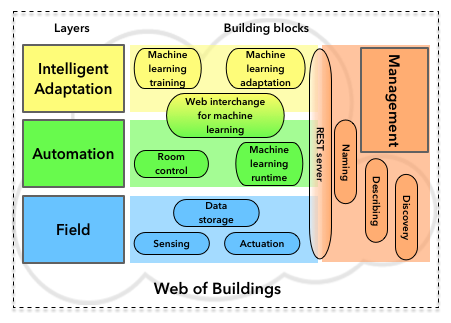
Buildings are increasingly equipped with dedicated automation networks, aiming to reduce the energy consumption and to optimize the comfort. On the other hand, we see the arrival of sensors and actuators related to the Internet of Things, which can naturally connect to IP networks. Due to constraints imposed by the obsolescence or physical properties of buildings, it is not uncommon that different technologies have to coexist.
These networks operate with different models and protocols, making the development of global automation systems difficult. Traditional models of distributed systems are not adapted to the context of sensor networks. The paradigm of the Web of Things is resource-based and strives to standardize the application layer of different objects using Web technologies, primarily HTTP and REST.
In this thesis, we use the Web of Things to create a framework dedicated to smart buildings, allowing developers to compose applications without knowledge of the underlying technologies.
By relying on Web technologies, we demonstrate the development of seamless services while reusing the available resources within the network (sensors and actuators), forming a self-managed cloud. In order to equip the buildings with a higher-level intelligence, we also demonstrated in this thesis the exposure of machine learning services made accessible through Web interfaces and hiding the complexity of the process.
Publications